Ad tests: what to check before you pay for clicks
In November I built Rosie, an AI companion who rings an older person every morning for a chat. The family gets a short text afterwards. I sold it as a Christmas gift: three months of calls for 99 pounds.
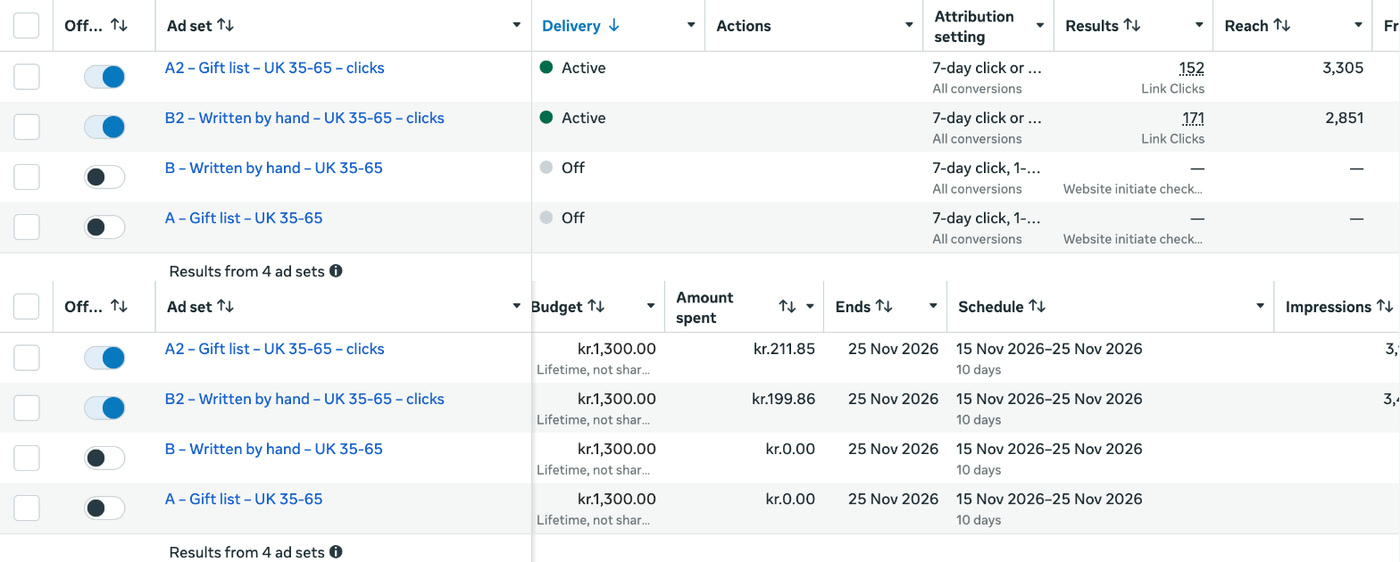
I made two ad films and set aside about 300 pounds for the test. In three days the ads got 323 clicks for about 48 pounds. Nobody bought. In the 160 page opens I counted, nobody pressed the buy button.
Then I did a sum I should have done first. After VAT and three months of calls, a 99 pound sale left about 21 pounds. My target was to pay up to 80 pounds in ads for each customer. The test could not have paid even if it had worked.
I closed it that day. This post is the list I now go through before I pay for a click. The picture below is the whole test as the ad tool shows it.
nine steps
- Work out what one sale leaves. Take the price, then take off tax and what it costs to deliver. For me that was 99 pounds, minus VAT, minus about 20 pounds a month for calls, texts and card fees, for three months. About 21 pounds was left.
- Set the most you will pay for a customer below that. My target was 80 pounds per customer. At about 15 pence a click, 21 pounds buys about 140 clicks. So I needed one sale in every 140 clicks just to pay for the ads.
- Let a few real users try it first. Rosie passed 9 of 12 checks when I played the older person myself. No real older person ever had a call. So the page had no proof to show, and 91 of 160 visitors left within ten seconds.
- Make the first screen say what the ad said. My ads promised a 99 pound Christmas gift. The page opened with a general headline, and the price came on screen 9 of 13. Day 1 brought 95 ad visitors and none of them played the demo call.
- Count on your own server. The ad tool only sees visitors who say yes to cookies. So the page logged four things on my own server, with no cookie: an open, a ten second stay, reaching the prices and each button press.
- Check the page on a small phone. 84 percent of my ad visitors were on Android phones. On a small screen the cookie question was 118 pixels high and sat on top of the buy button.
- Read who clicked on day 1. After a day and a half, a third of the money had gone to ads inside other apps and games. Six in ten clicks came from people aged 65 and over. I wanted their children. The click price looked great and told me very little.
- Pick a goal the ad tool can learn from. My ads first looked for people who start a checkout. The page had never recorded one, so no ad was shown for 13 hours. I switched to link clicks. That bought clicks and nothing more.
- Write down what counts as a no. Before the first click I wrote that 0 sales means stop. Later I added a second rule: 100 visitors on the new offer with no button press means pause. When the sums came in, closing was easy.
the numbers
| Step | Count |
|---|---|
| Link clicks on the ads, 15 to 17 Nov | 323 |
| Page opens counted, from 16 Nov | 160 |
| Stayed ten seconds | 69 |
| Scrolled to the prices | 6 |
| Pressed "hear a call" | 3, and one was my own test |
| Pressed buy or ring | 0 |
| Sales | 0 |
From the ad tool and my own server log, read on 17 November 2026. The page count started a day after the ads, so the 160 opens belong to the later clicks. I rebuilt the page during the test and the prices moved further down, so the 6 is a rough number. Spend was 411.71 kroner, about 48 pounds.
what it looks like
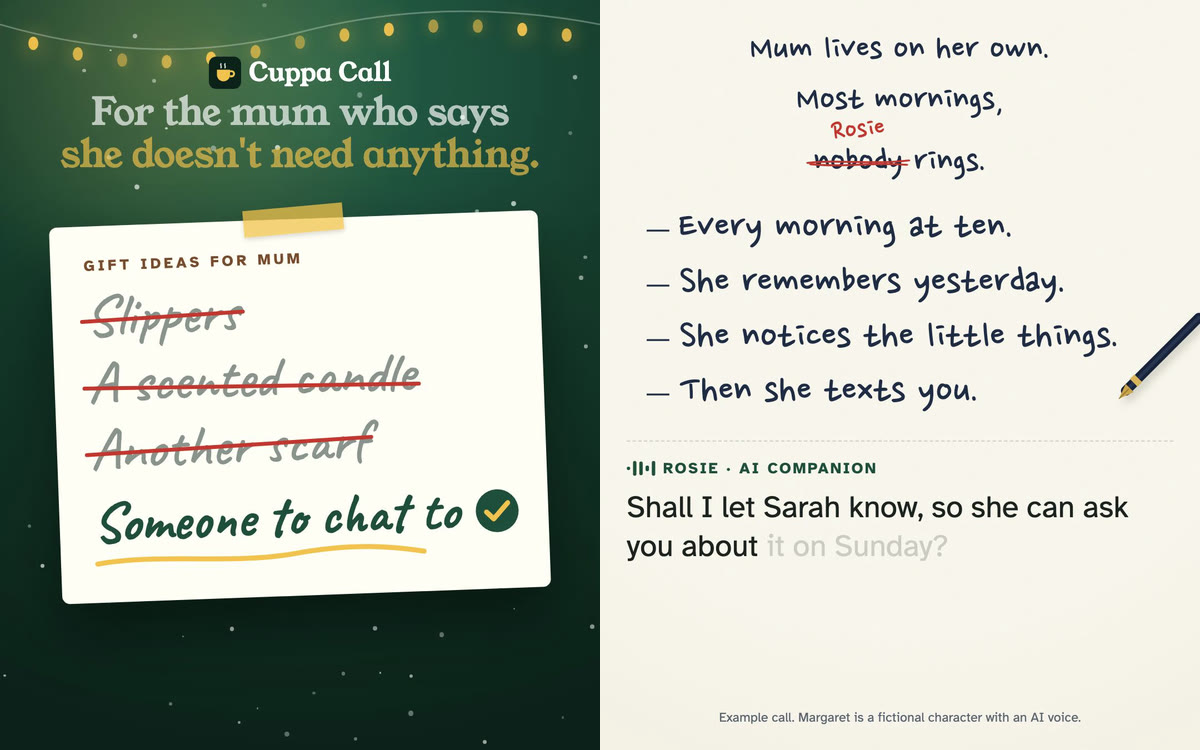
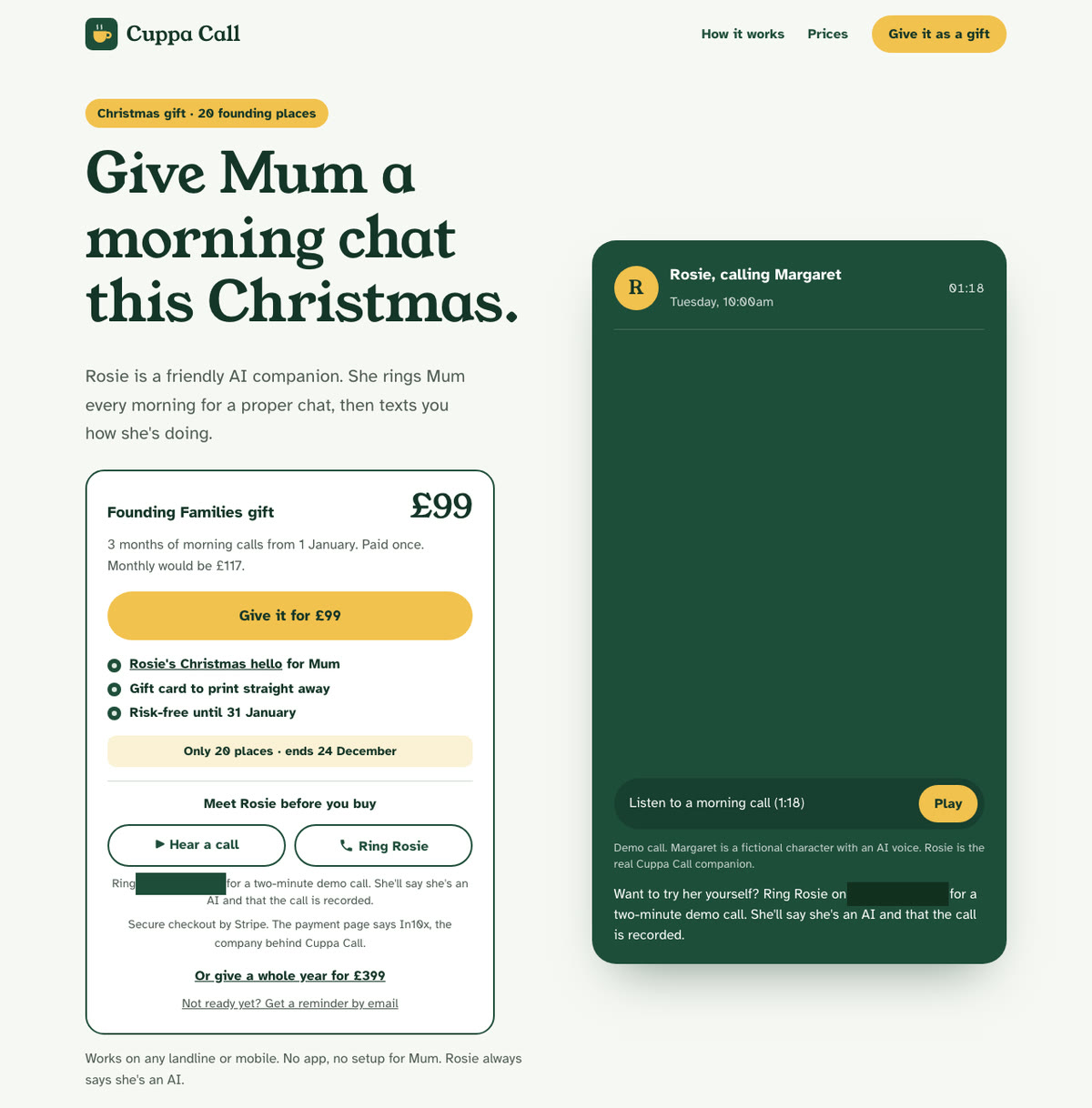
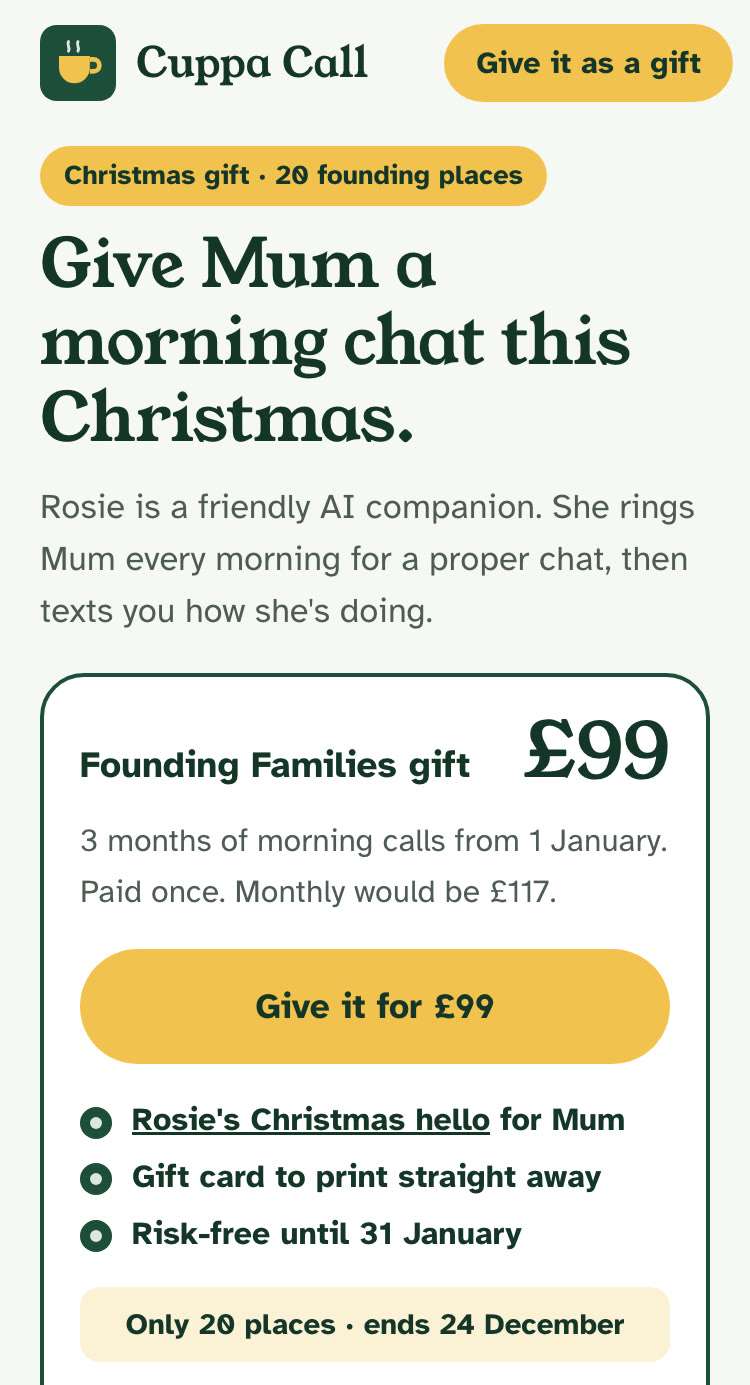
mistakes I made along the way
- I set an ad target of 80 pounds per customer for a product that left about 21 pounds per sale.
- I ran ads before any real older person had talked to Rosie.
- I left the ad tool's automatic audience and placements on. A third of the first money went to ads inside games and other apps.
- I took a placement out and did not look again. The tool had ticked a box that still sent about 5 percent of the budget there.
- I sent ad traffic to a page whose first screen did not match the ad.
- I sold a gift that would start on 1 January. My guess is that a reward weeks away is hard to sell to a stranger. 323 clicks cannot prove that.
where each lesson comes from
- Cuppa Call: a morning phone call from an AI companion, sold as a gift. 323 clicks, 160 counted page opens, 0 presses on buy and 0 sales. A sale would have left about 21 pounds.
- DialDynamo: an AI receptionist for US trades. 254 of 254 tests passed and 0 paying clients. A product that works did not sell itself there either.
- Selling AI visibility audits. Three offers with working checkouts and no recorded sale. An ad campaign was built there and never switched on.
the short version
- What one sale leaves after tax and running costs.
- A highest ad cost per customer that is below that.
- A few real users first, so the page has proof.
- A first screen that repeats the ad.
- Your own count of opens, stays and button presses.
- The page checked on a small phone with the cookie question showing.
- Ages and placements read on day 1.
- A written rule for when to stop.
changes to this post
- 17 November 2026. First version, written the day the test closed.