in10x / lab / migraine-depression-ai-answers
What AI assistants tell people about migraine and depression
The question. When people ask ChatGPT and Claude about migraine, depression and schizophrenia, which companies and medicines do the answers name, and which sources do they trust? Does it change between the United States, Denmark and Germany?
what I built
The same pipeline as the health citations study, now with two assistants. 12 questions in English, Danish and German: four general, four about a type of medicine and four that name a company or product. ChatGPT answered each question twice through the API with web search, Claude once. Every answer is stored, every company and product name is counted, and every cited link gets a source type.
Python · SQLite · OpenAI Responses API with web search · Claude Code · Playwright
what happened
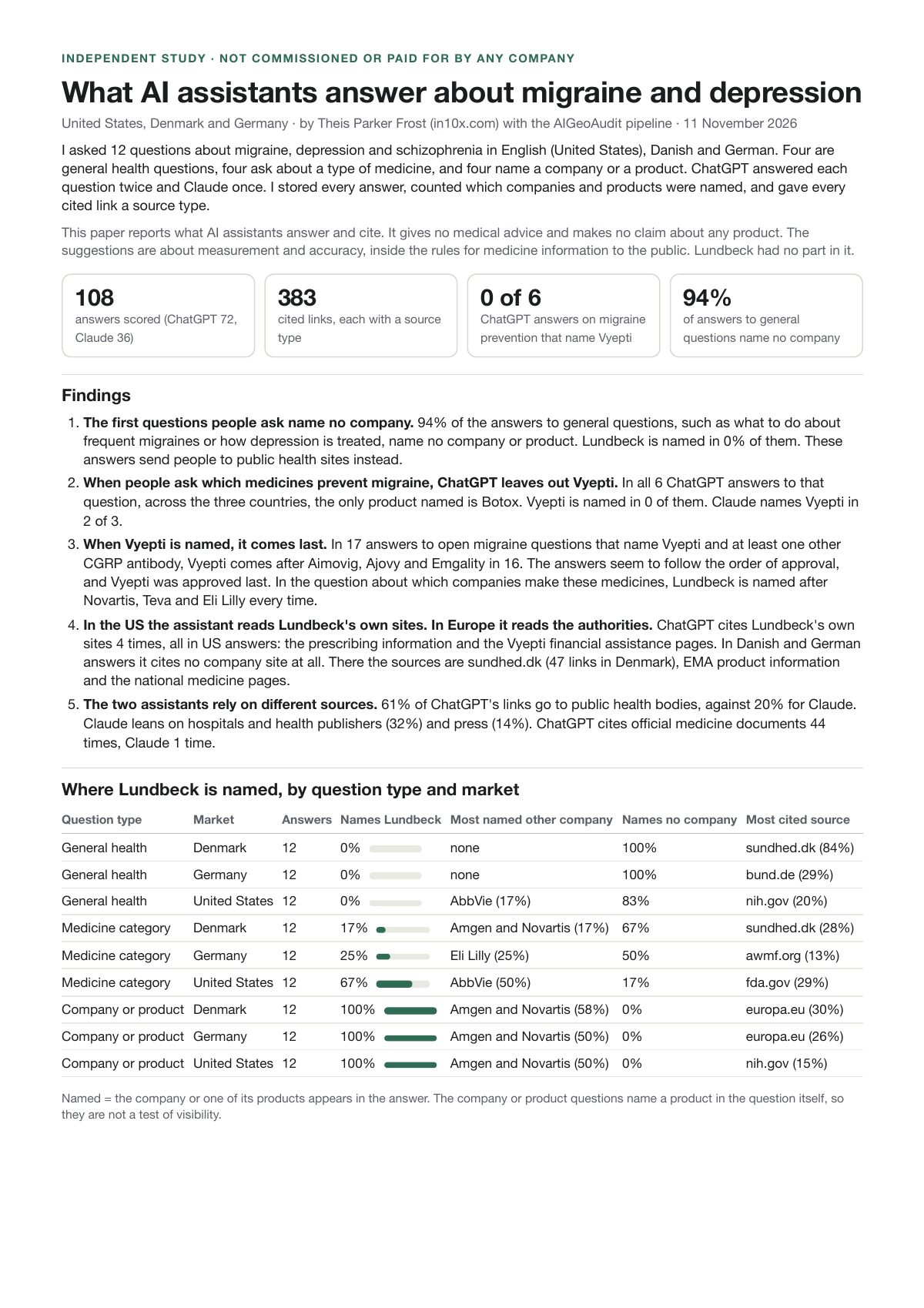
- 108 answers (72 from ChatGPT, 36 from Claude) with 383 cited links. 7 links have no source type yet.
- 94 percent of the answers to general questions name no company or product.
- Asked which medicines prevent migraine, ChatGPT named only Botox in all 6 answers. Vyepti was in 0 of them. Claude named it in 2 of 3.
- In 16 of 17 answers that list Vyepti next to another CGRP antibody, Vyepti comes after Aimovig, Ajovy and Emgality.
- ChatGPT cited Lundbeck's own sites 4 times, all in US answers. In Danish and German answers it cited no company site at all.
- 61 percent of ChatGPT's links went to public health bodies, against 20 percent for Claude.
- Only 45 percent of cited sources stayed the same between two identical ChatGPT runs.
Cost. About 1.50 USD in API calls for the 72 ChatGPT answers. The Claude answers ran inside my Claude Code plan.
screenshots
what broke
- The first scoring left 27 percent of links without a source type. 60 new rules brought it down to 2 percent, with no new API calls.
decision
A small study that shows direction, not precision. Next step is a fixed question set that runs every week, so the numbers become a trend instead of a snapshot.
Every number on this page comes from the project's own logs, analytics or database. Back to the lab.